


Every July, NAIDOC Week arrives with a familiar sense of energy, as there are concerts, festivals, community gatherings and playlists dedicated to Aboriginal and Torres Strait Islander artists in Australia. First Nations musicians take over stages and radio stations, while institutions across Australia temporarily turn their attention toward the oldest continuing cultures on the planet.
It is easy, amid all that noise and colour, to forget where the week came from. NAIDOC did not begin as a celebration. It began as a protest. On January 26, 1938, Australia was busy celebrating itself, as the country was marking 150 years since the arrival of the First Fleet, with official events presenting colonisation as the beginning of a national success story. Aboriginal activists had a different anniversary in mind.
They called it the Day of Mourning. William Cooper, William Ferguson, Jack Patten, Margaret Tucker, Douglas Nicholls and other Aboriginal leaders were not gathering to celebrate survival in the abstract. They were confronting the conditions Aboriginal people continued to live under after 150 years of British rule. The movement demanded justice, representation and fundamental political change.
The distance between that protest and the NAIDOC Week we know today is enormous. It is also the reason the week exists at all. Over the following decades, the Day of Mourning evolved. By 1957, the observance had moved from January to July and developed into a day of remembrance and celebration. It later expanded into a full week, and in 1991 the name NAIDOC formally recognised Torres Strait Islander peoples. The language surrounding the movement changed, but its politics never disappeared.
Music, however, has never been quite so easy to separate from the story. Aboriginal and Torres Strait Islander music existed for thousands of years before there was an Australian music industry to recognise it. Song carried knowledge, history, relationships and connections to Country. Manikay could hold clan and family histories. Songlines mapped journeys across land and sky through music, story, dance and art. Music was not an accessory to culture; it was one of the ways culture lived.
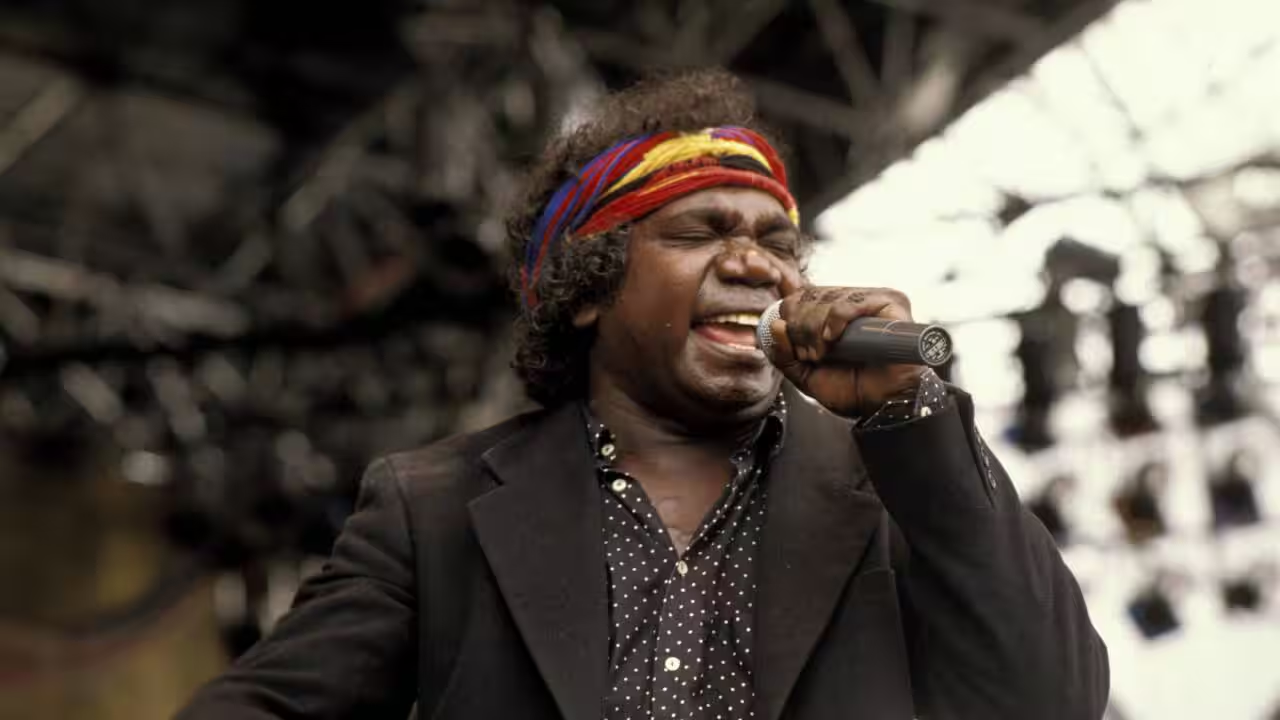
That makes the history of contemporary First Nations music more than a story of artists finally breaking into the mainstream. It is also a history of musicians learning how to use the mainstream without being swallowed by it. Few bands understood that better than Yothu Yindi.
When then-prime minister Bob Hawke attended the Barunga Festival in 1988, he was presented with the Barunga Statement and promised that a treaty between Indigenous Australians and the federal government would follow. By 1991, it had not. Yothu Yindi turned the broken promise into Treaty.
The brilliance of Treaty was not simply that it carried a political message. Plenty of protest songs do that. What made it extraordinary was the way the song moved. Rock guitars, keyboards and drums met bilma and yidaki. English existed alongside Gumatj. Yolngu and Western musical structures were not treated as opposing forces; they occupied the same song. Then the remix arrived.
The Filthy Lucre version pushed Treaty onto dancefloors and into the charts, where it reached top of the charts. It became the first song by a predominantly Aboriginal band to chart in Australia, carrying an unfulfilled political promise into clubs, cars and living rooms across the country. There is something almost perfect about that contradiction. One of Australia’s most important protest songs became a dance hit.
That same tension still runs through NAIDOC Week. Celebration and resistance are not opposites here. Joy does not erase politics, and a dancefloor does not make a message less serious. For people whose cultures have survived deliberate attempts at suppression, the act of being visible, loud and culturally specific can carry its own weight. First Nations artists have spent decades moving through rock, country, pop, hip-hop and electronic music without surrendering the histories that came before them. Sometimes the message is explicit. Sometimes it lives in language, instrumentation or the decision to tell a story from a perspective the Australian mainstream has historically ignored.