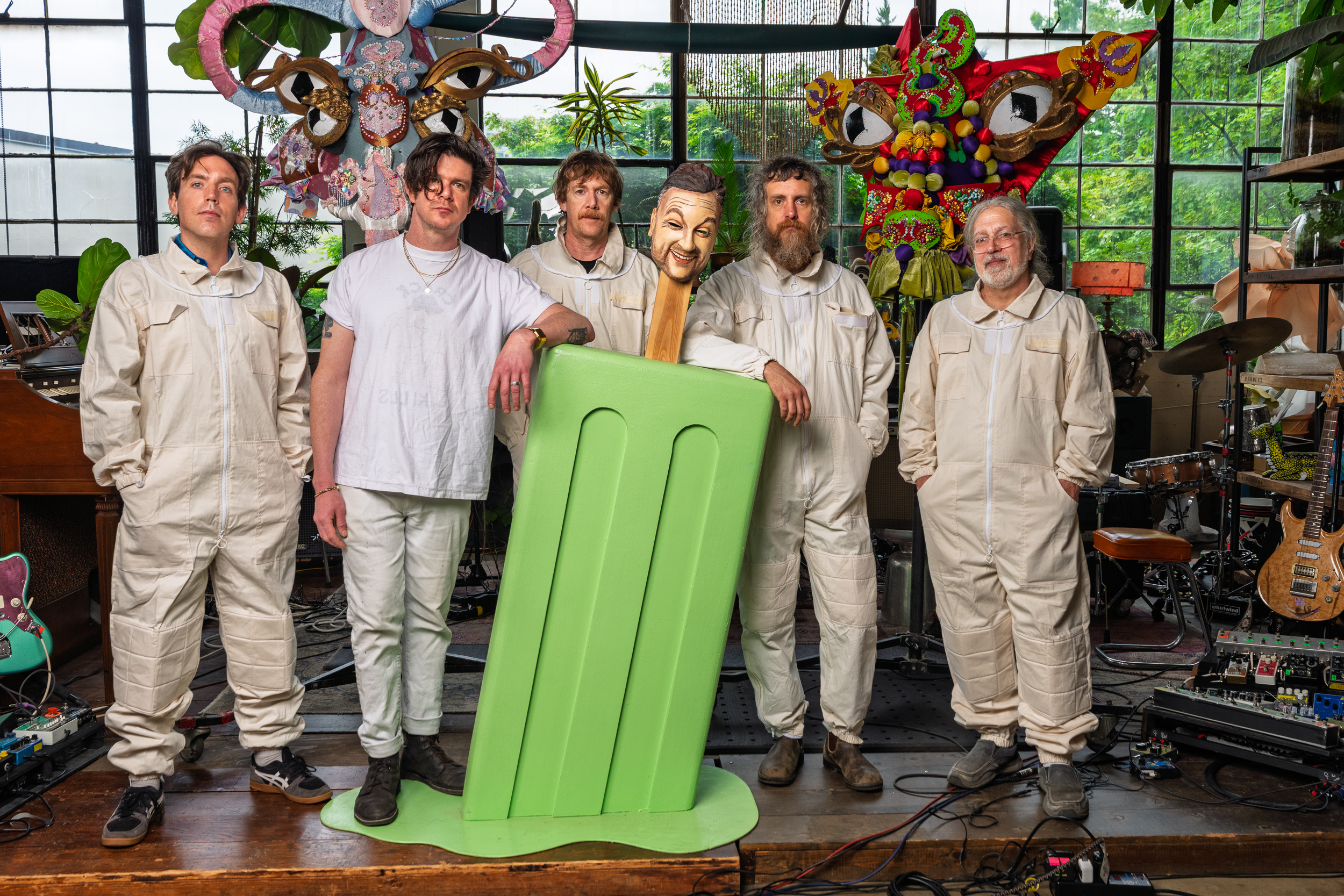



Five years is a long time to wait for a Modest Mouse album… In that time, the world changed, indie rock continued to mutate in strange directions, and perhaps most significantly for the band, they lost founding drummer Jeremiah Green. So when “An Eraser and a Maze” finally arrived, it carried far more weight than simply being the follow-up to 2021’s The Golden Casket. It arrives as a record shaped by grief, survival and reinvention, while somehow still sounding unmistakably like Modest Mouse.
For a band that has spent more than three decades turning existential dread into strangely cathartic indie rock, that balancing act feels entirely appropriate. From the opening moments of Picking Dragons’ Pockets, it’s clear that Isaac Brock isn’t interested in delivering a nostalgic victory lap. Instead, the album embraces the chaos that has always defined Modest Mouse: The guitars are jagged, the arrangements constantly shift direction, and Isaac’s unmistakable voice remains equal parts philosopher, prophet and unhinged narrator. Yet beneath the familiar unpredictability lies something different this time around: a sense of reflection.
Grief hangs over An Eraser and a Maze without ever fully consuming it, as Jeremiah Green’s absence is impossible to ignore, but Isaac wisely avoids turning the record into a direct elegy. Instead, the loss seems to exist in the background, influencing the emotional texture of the songs rather than dominating them. Reviewers have already identified grief as one of the album’s defining themes, and it’s easy to understand why. Many of these songs feel like conversations with memory itself.
What makes the album so compelling, is that it never stays in one emotional place for too long. Modest Mouse have always excelled at making the strange feel accessible, and An Eraser and a Maze continues that tradition. One moment the band sounds meditative and almost delicate; the next they’re charging forward with the kind of anxious energy that made classics like The Moon & Antarctica and The Lonesome Crowded West so enduring.
Tracks like Third Side of the Moon and Absolutely Necessary Never showcase the band’s ability to make philosophical questions feel oddly fun, while songs such as Impossible Somedays provide some of the album’s most emotionally resonant moments. Even the shorter pieces and interludes contribute to the feeling that you’re wandering through a deliberately disorienting landscape where every turn reveals something unexpected.
The record benefits enormously from its collaborative approach. Produced by Issac alongside Jacknife Lee, Suzy Shinn and Justin Raisen, the album never feels locked into a single sonic identity. Instead, it pulls from decades of Modest Mouse history while allowing new textures and ideas to emerge. The result is an album that feels simultaneously familiar and adventurous. Since emerging from the Pacific Northwest indie scene in the 1990s, the band has consistently resisted easy categorisation, as they have moved between lo-fi experimentation, indie rock, post-punk energy and pop accessibility without ever losing their core identity. An Eraser and a Maze feels like the latest chapter in that story rather than an attempt to recreate past glories.
Many legacy acts reach a point where new records feel secondary to the catalogue that came before them. However, Modest Mouse’s “An Eraser and a Maze” doesn’t suffer from that problem. It sounds like a band that still has questions to ask, ideas to explore and emotions to process.